




Back to overview
Expert case by
Alberto

MBB First Round - StayPro - Consumer Growth Strategy

Difficulty: Intermediate
Candidate-led
4.5
< 100 Ratings
Times solved: 1.0k

Case Prompt:

Your client is StayPro, a San Francisco based technology company that develops and sells wearable and mountable action cameras. StayPro’s CEO believes that the company’s growth has stagnated and has hired you to remedy that issue.

Overview of All Exhibits
Practice makes the difference
Practicing alone helps – with a partner it’s even better. Solve this case in a realistic mock interview.
Schedule on Meeting Board

Part 1: structuring the case

What are the main factors to identify what might be causing the growth stagnation for StayPro?

Show additional information Hide additional information
Show solution Hide solution

Part 2: understand market and expected gross profit

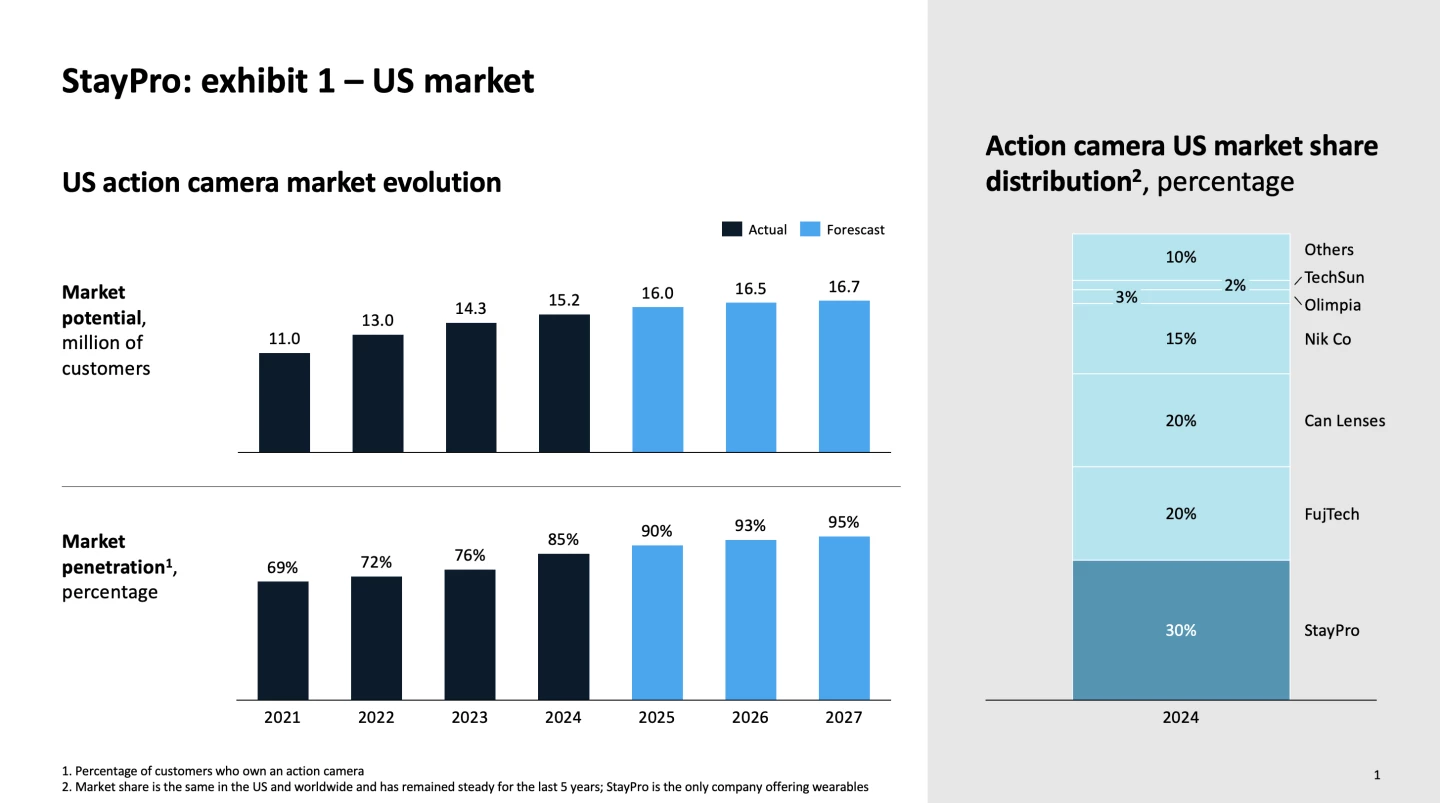
We have collected the following market data (exhibit 1).

What can you conclude from the charts? What is the expected gross profit for 2025?

Show additional information Hide additional information
Show solution Hide solution

Part 3: growth alternatives

How can StayPro boost their top-line (revenues)?

Show additional information Hide additional information
Show solution Hide solution

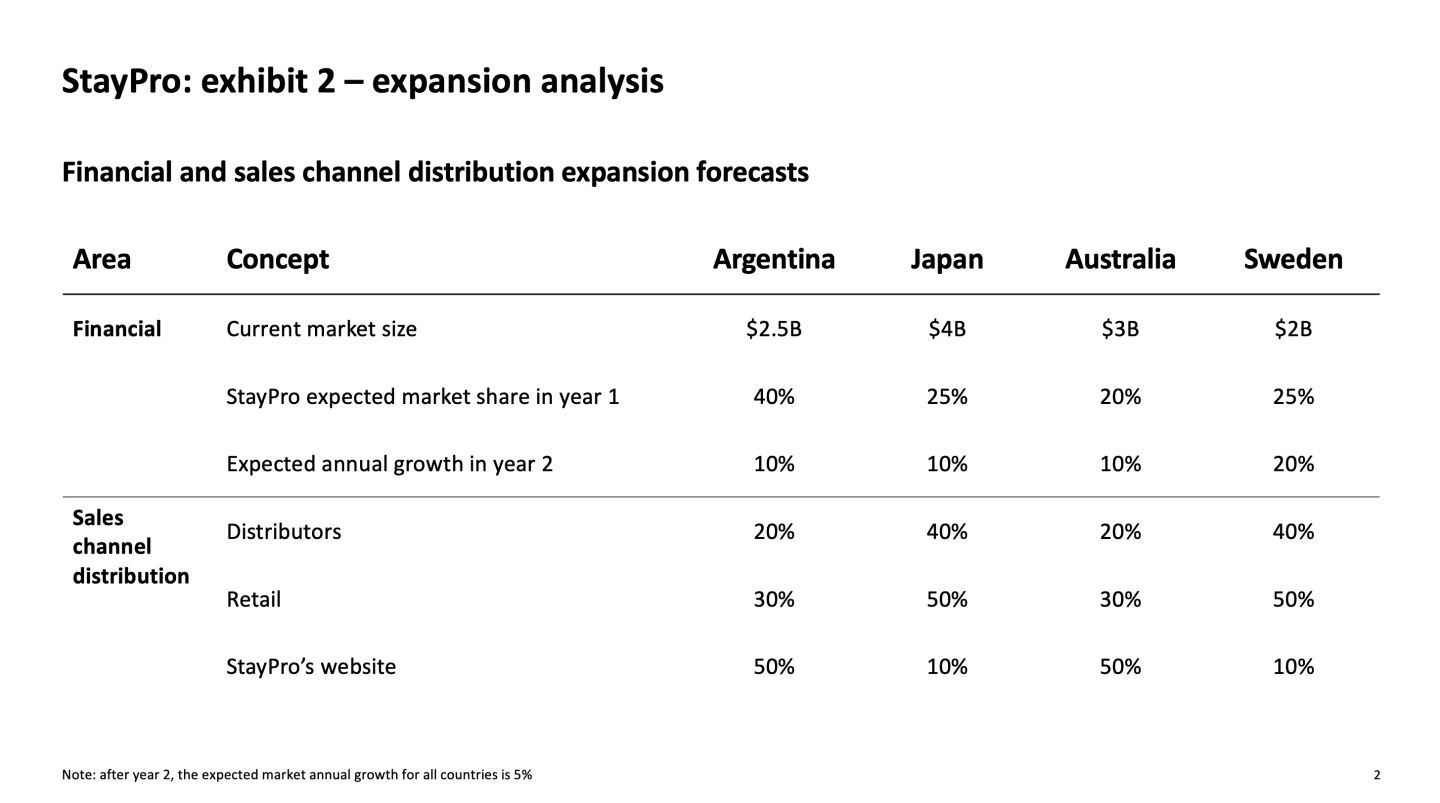
Part 4: geographical expansion

What is the most attractive market for StayPro to expand their operations and increase top line?

Show additional information Hide additional information
Show solution Hide solution

Part 5: final recommendation

We are meeting the client CEO soon. What is your final analysis and recommendation for StayPro? 

Show additional information Hide additional information
Show solution Hide solution
Practice This Case With Peers Who Are Currently Looking for Interview Partners.
Do you have questions on this case?
Ask our community and receive answers and tips directly from our experts.
Ask a question Ask a question
Related Case Interview Basics Articles
GROW Model
Useful Business Analysis Tools
The GROW model, an acronym for Goal, Reality, Options, and Will, was developed in the late 1980s by Sir John Whitmore and his colleagues Graham Alexander and Alan Fine. It emerged from the realization that traditional training methods often failed to achieve sustainable performance improvements. Whitmore, a former racing driver and a pioneer in the field of executive coaching, played a significant role in popularizing the model and establishing it as a method for performance enhancement in the business world.
To the article
McKinsey Growth Pyramid
Useful Business Analysis Tools
The McKinsey Growth Pyramid is a strategic tool that helps businesses systematically explore growth opportunities. As the name suggests, it was developed in the 1980s by the renowned management consulting firm McKinsey & Company. It prioritizes different approaches to expansion and offers a structured roadmap for companies to increase revenue, expand their market presence, and drive long-term sustainability. This framework is widely used in consulting, including in case interviews, as it provides a clear methodology to assess how companies can scale efficiently.

To the article
Interviewer- vs. Candidate-Led Cases
Basics of Case Interviews
Every case interview has a certain structure. An important factor on how your case interview is going to proceed is if the interview is interviewer-led or candidate-led.We’d like to explain the two interview formats – candidate-led cases and interviewer-led cases – highlight their differences, and provide you with tips on how to excel in each of them.
To the article
The Influence Model
Useful Business Analysis Tools
The McKinsey Influence Model was developed in the early 2000s and is the result of extensive research and practical experience by consultants. Originally designed to help companies tackle challenges, the model has now established itself as an indispensable framework in the field of consulting.
To the article
The Blue Ocean Strategy
Common Terms of Business
The Blue Ocean Strategy, developed by W. Chan Kim and Renée Mauborgne in their book Blue Ocean Strategy (2005), turns traditional business thinking upside down. It focuses on tapping into undiscovered markets – the "blue oceans" – where companies can operate alone and avoid competition. The result? More growth and higher profits.In contrast, the "red ocean" refers to the already overcrowded market space where competition is fierce, and companies are constantly striving to outdo each other. This often leads to declining profits and limited growth. 🌊The Blue Ocean Strategy represents a shift away from this destructive competition towards a more constructive and creative form of market development. It encourages companies to go beyond the industry's conventional boundaries and create new markets, making competition irrelevant.
To the article
Practice makes the difference
Practicing alone helps – with a partner it’s even better. Solve this case in a realistic mock interview.
Add invitation
Do you have questions on this case?
Ask our community and receive answers and tips directly from our experts.
Ask a question Ask a question