

Back to overview
Expert case by
Dennis

Opportunity Assessment: Alternative Revenue Streams for a Salt Mine

Difficulty: Intermediate
Candidate-led
0.0
0 Ratings
Times solved: 700+

Case Prompt:

Salty Boy Inc. is an underground salt mine in Texas whose new leadership are supporters of the circular economy. Circular economy provides a pathway towards more sustainable production and consumption patterns – CE introduces circularity to many areas of production cycles and encourages using renewable, regenerative inputs (e.g., energy) and minimizing systematic leakage (e.g., waste).

After decades of extracting salt form the earth, Salty Boy’s new leadership find themselves in possession of a network of empty, temperature and moisture stable tunnels located conveniently near major fiberglass waste sources and logistics networks. As a result, Salty Boy sees the potential for an alternative revenue stream. Their rationale is that they have ample and well-located storage capacities in their tunnels that they could use to position themselves well for an emerging recycling trend that could turn fiberglass waste into an eco-friendly and valuable raw material. Salty Boy is looking for your help to assess this potential opportunity. 

Overview of All Exhibits
Practice makes the difference
Practicing alone helps – with a partner it’s even better. Solve this case in a realistic mock interview.
Schedule on Meeting Board

Selection of Focus Industries

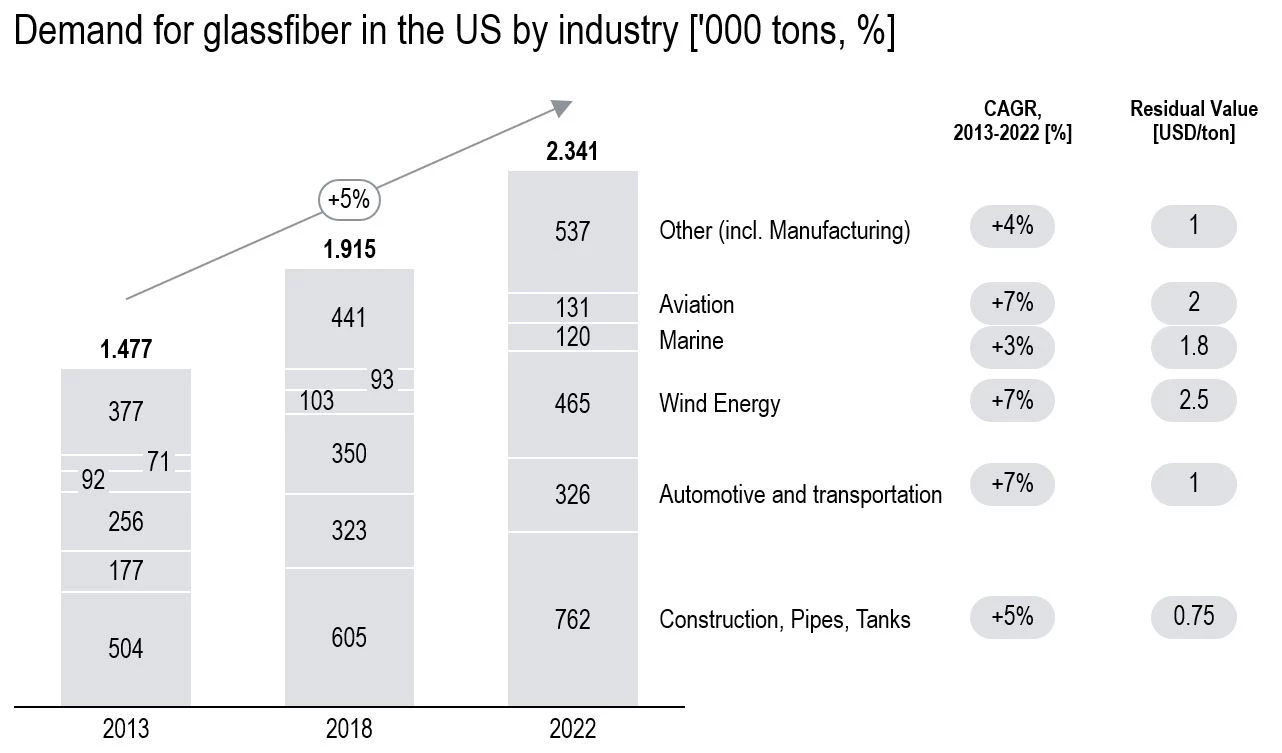
Your initial research shows that fiberglass is used in several industries with different supply profiles (see Exhibit 1). The projected residual value of the respective fiberglass varies based on factors such as cost of transportation, ease of collection and packaging.

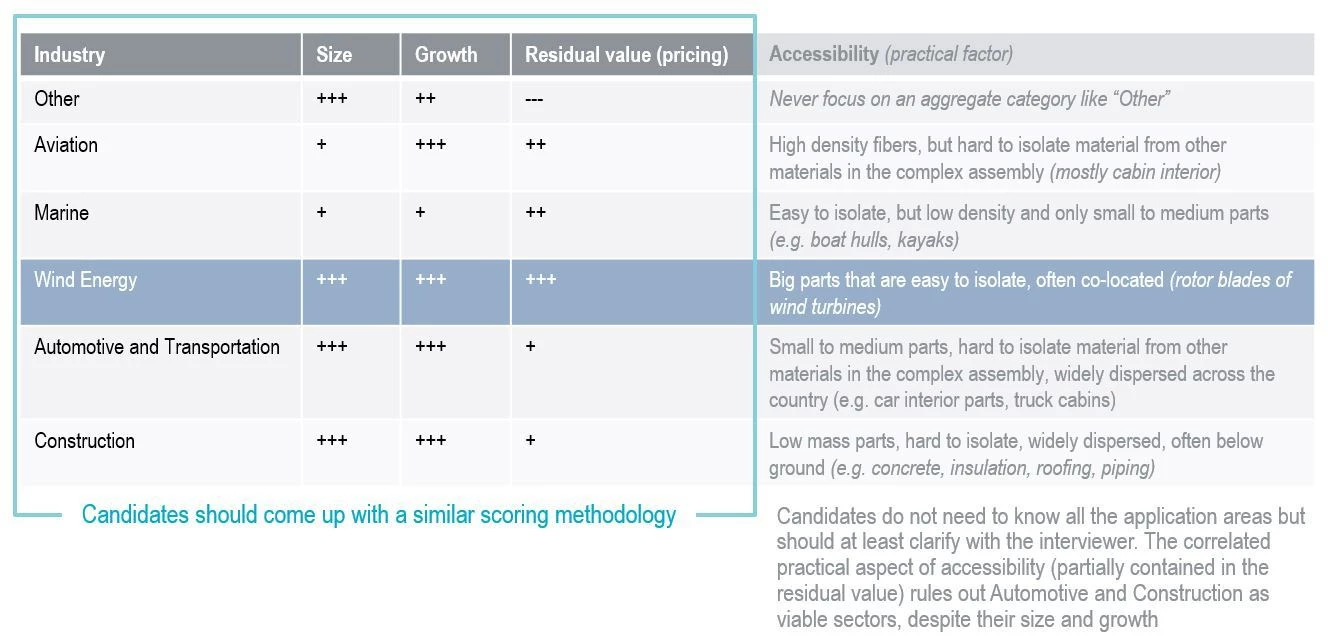
Which of the industries should Salty Boy focus on? Why?

Show additional information Hide additional information
Show solution Hide solution

Addressable Market

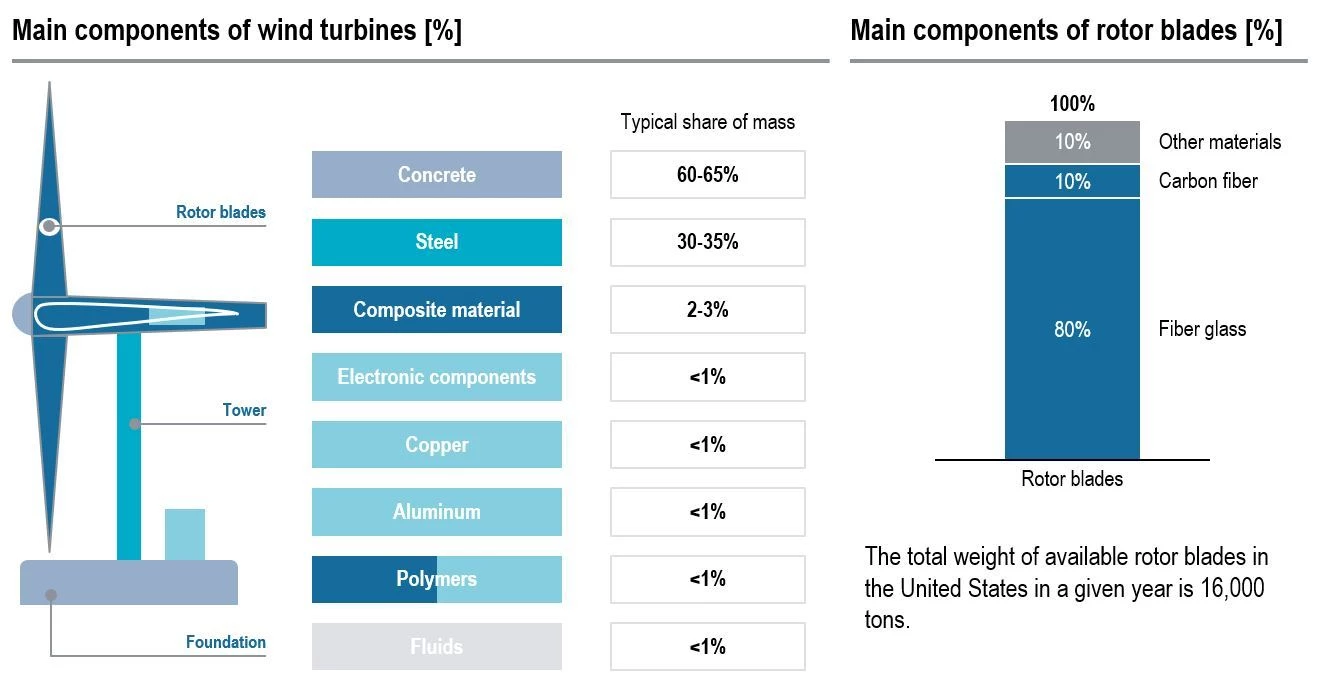
How big is the addressable market for the Wind Energy industry in the US? What would you recommend Salty Boy?

Show additional information Hide additional information
Show solution Hide solution

Alternative Revenue Streams

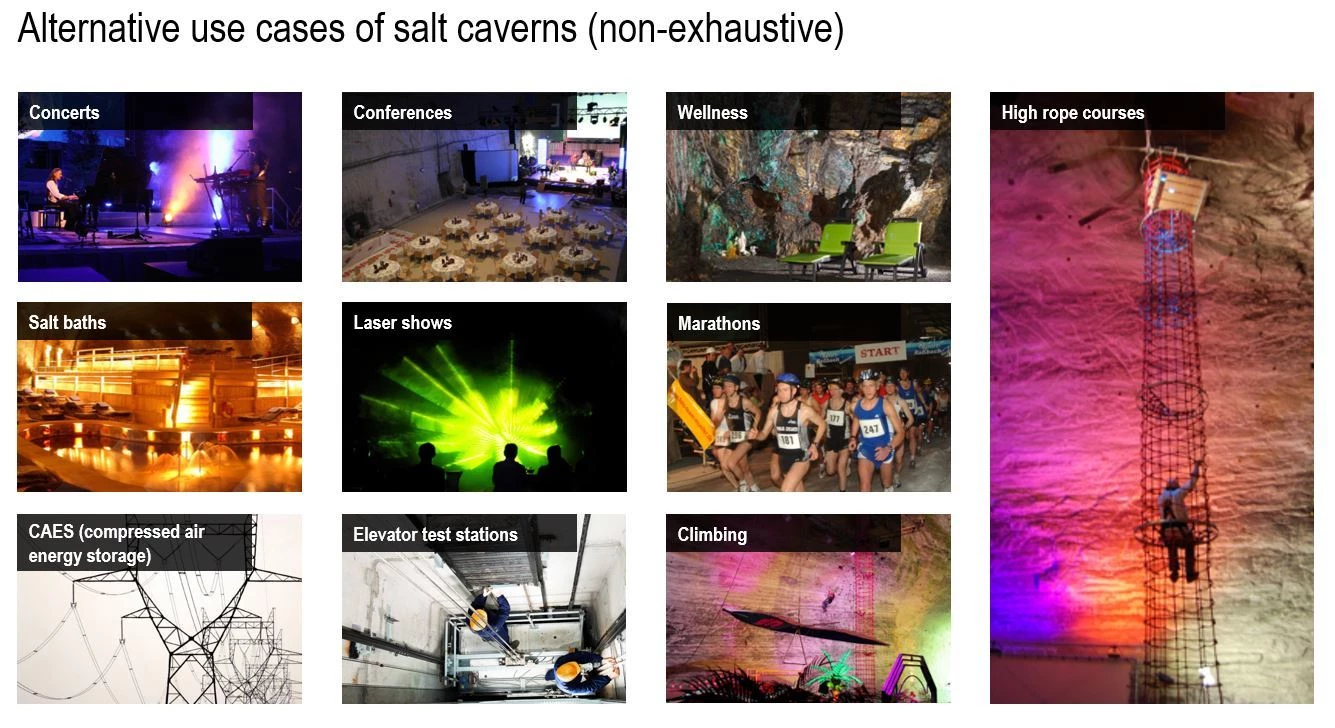
There are multiple other options the salt caverns could be used (Exhibit 3). How would you segment the different options? Based on which criteria would you evaluate the different options?

Show additional information Hide additional information
Show solution Hide solution
Practice This Case With Peers Who Are Currently Looking for Interview Partners.
Do you have questions on this case?
Ask our community and receive answers and tips directly from our experts.
Ask a question Ask a question
Related Case Interview Basics Articles
GROW Model
Useful Business Analysis Tools
The GROW model, an acronym for Goal, Reality, Options, and Will, was developed in the late 1980s by Sir John Whitmore and his colleagues Graham Alexander and Alan Fine. It emerged from the realization that traditional training methods often failed to achieve sustainable performance improvements. Whitmore, a former racing driver and a pioneer in the field of executive coaching, played a significant role in popularizing the model and establishing it as a method for performance enhancement in the business world.
To the article
The Tuckman Model
Common Terms of Business
At the core of comprehending team dynamics is the ingenious creation of Bruce Tuckman, the Tuckman Model. Bruce Tuckman, an eminent psychologist and researcher, introduced this model in 1965, and it has since been a fundamental framework for understanding team behavior and guiding team development.Tuckman, with his deep-rooted interest in group dynamics, recognized the evolution teams go through in their journey towards high performance. His model offered a lucid, linear path for this evolution, making it easily understandable and implementable in varied team environments.His ground-breaking work has led to profound shifts in how organizations manage their teams, promoting a more empathetic and result-oriented approach. Tuckman's model stands out as an insightful roadmap that helps navigate the complex maze of team development, and its utility spans multiple disciplines and industries.In a consultancy environment, the model is especially relevant due to the constant team reshuffling and the high value placed on effective teamwork. With consultants often stepping into pre-established teams, understanding the team's current developmental stage - whether it's forming, storming, norming, performing, or adjourning—is invaluable.By using Tuckman's model as a reference, consultants can quickly assess team dynamics, identify issues, and devise strategies to move the team towards the next stage. In essence, Tuckman's model provides a clear framework that can be used to maximize team effectiveness, making it a critical tool in the consultant's toolkit.
To the article
Kotter Change Management Model
Useful Business Analysis Tools
As graduates venturing into the world of consulting, it is essential to equip ourselves with effective change management frameworks. One such model that holds significant importance is the 8-Step Kotter Change Model. Developed by renowned leadership expert John P. Kotter, it is a widely recognized framework that helps organizations navigate through periods of change. Originally introduced in 1995, this 8-Step Model has become one of the go-to methods for supporting employees and managers during times of transformation. In the world of consulting, where change is a constant, understanding and effectively utilizing this model is essential for success. Overview of the 8-Step Kotter Change ModelKotter's model is based on Kurt Lewin's field theory and draws insights from successful change projects in large organizations. It emphasizes the importance of people and effective communication in driving sustainable change within a company. By addressing resistance, creating a shared vision, and embedding new behaviors, the model aims to facilitate successful organizational transformations.The 8-Step Model serves as a roadmap to guide organizations through change initiatives. It comprises a sequence of steps that address various crucial elements of the change process.  Here is a brief overview of each step:Create a sense of urgency: This step involves creating awareness and a compelling reason for change, emphasizing the need for immediate action.Build a guiding coalition: Forming a dedicated team of influential individuals who share a common vision and have the capability to drive change is crucial for its successful implementation.Form a strategic vision and initiatives: Developing a clear and compelling vision for the future state of the organization, along with actionable initiatives, provides a roadmap for change.Enlist a volunteer army: Effective communication of the vision to all stakeholders helps foster understanding, alignment, and commitment towards the change effort.Enable action by removing barriers: Empowering employees to take ownership and initiative in driving the change process helps to overcome resistance and promotes a culture of collaboration.Generate short-term wins: Celebrating and showcasing early wins in the change journey boosts morale, builds momentum, and creates confidence in the change process.Sustain acceleration: Building upon the initial successes, it is crucial to sustain the momentum of change and drive further improvements to solidify the new ways of working.Institute change: To ensure the longevity of the change, embedding new behaviors and practices into the organizational culture is vital, fostering a sustainable transformation. Benefits of the 8-Step Kotter Change ModelThe Kotter Change Management Model offers several advantages for consultants:Structured approach: The model provides a systematic and well-defined framework to guide consultants through the complex process of change management, ensuring a methodical approach achieving desired outcomes.Stakeholder engagement: By involving key stakeholders at various stages, the model encourages collaboration, creates buy-in, and fosters a sense of ownership, which is essential for successful change implementation.Agility and flexibility: The model recognizes the importance of adaptability, enabling consultants to navigate unexpected challenges and adjust strategies based on feedback and evolving circumstances.Focus on short-term wins: The emphasis on generating early successes helps consultants gain credibility, build support, and maintain momentum throughout the change journey. Limitations and ConsiderationsSimplification: The model provides a simplified view of the change process, and real-world situations may involve additional complexities that need to be addressed.Contextual factors: The model does not explicitly address industry-specific or organizational context factors, which may require customization and adaptation of the steps. Importance of the Model for ConsultantsClient engagement: The model enables consultants to engage clients in a structured change management process, fostering trust and establishing their expertise in driving successful transformations.Change leadership: By applying the model, consultants can effectively lead change initiatives, align stakeholders, and guide organizations towards desired outcomes, establishing themselves as trusted advisors.Framework for analysis: The model provides a framework to analyze the current state of organizations, identify gaps and opportunities, and develop comprehensive change strategies, enhancing the value consultants bring to their clients. ConclusionAs aspiring consultants, mastering the 8-Step Kotter Change Model can significantly enhance our ability to drive successful change initiatives. Its structured approach, stakeholder engagement, and focus on short-term wins make it a valuable tool for guiding organizations through complex transformations. By understanding and applying this model, we can contribute to the success of our clients' change journeys and establish ourselves as effective change agents in the consulting industry.Further Reading:Download Kotter's 8-Steps Ebook here.
To the article
ADKAR Model
Useful Business Analysis Tools
The ADKAR Model, developed by Jeff Hiatt, founder of Prosci, is a practical change management framework. It's designed to help organizations to successfully implement change and increase employee acceptance. As one of the most popular models for change management, ADKAR highlights an often overlooked fact: changes can only be successful if employees are actively involved.🔎 In this article, we'll introduce you to the components of the ADKAR Model and how it can be applied to challenges within organizations. 
To the article
The Business Model Canvas
Useful Business Analysis Tools
Today, disruptive technologies and rapidly changing customer preferences have redefined the way we work. This is where the Business Model Canvas (BMC) comes into play. It is an effective method for analyzing and designing business models. Originally developed by Strategyzer, it has become an indispensable tool for consultants worldwide. ⚒️✨
To the article
Practice makes the difference
Practicing alone helps – with a partner it’s even better. Solve this case in a realistic mock interview.
Add invitation
Do you have questions on this case?
Ask our community and receive answers and tips directly from our experts.
Ask a question Ask a question